
Corporate values serve as fundamental principles and beliefs that guide crucial actions and behaviors, such as how business decisions are made and successful relationships are formed. The best values are not merely abstract ideals; they are practical tools designed to provide clarity and direction, especially in situations where formal policies may be absent or ambiguous. In the dynamic landscape of business, it’s impossible to create a policy for every conceivable scenario. This is precisely where corporate values come into play, empowering employees to make sound judgments that align with the company’s core identity and long-term objectives.
Corporate values act as an internal compass, helping individuals navigate complex situations and choose actions that reflect the organization’s ethical standards and strategic vision. For example, a company that values “customer-centricity” would expect its employees to prioritize customer satisfaction when clear guidelines for a given situation may not exist, or even if it means going beyond the strict wording of a policy. Similarly, a value of “innovation” encourages employees to explore new ideas and take calculated risks, fostering an environment of continuous improvement.
Once established, a strong set of corporate values becomes an invaluable asset in both recruitment and performance management. Organizations can proactively shape and reinforce their desired culture by actively recruiting candidates who align with these values. This “values-based hiring” approach moves beyond assessing skills and experience, focusing instead on whether a candidate’s personal principles resonate with the company’s ethos. This ensures that new hires not only possess the necessary technical capabilities but also contribute positively to the organizational culture, resulting in a more cohesive, engaged, and productive workforce.
A Case Study in the Power of Corporate Values
Consider the following case study on the power of corporate values:
In 1932, Herbert J. Taylor was tasked by creditors with saving the Club Aluminum Company from bankruptcy. The cookware and household item distributor owed creditors over $400,000 more than its assets, yet remained operational. To provide operating cash, a $6,100 loan was secured from a Chicago bank. Despite offering a good product, the company faced stiff competition from rivals with well-advertised brands, similarly talented personnel, and significantly stronger financial positions.
Given these immense challenges, the company needed a distinct competitive advantage. This differentiator was identified as the character, dependability, and service-mindedness of its employees, which effectively became the company’s core values. The company’s initial step involved carefully selecting personnel who naturally embodied these values. Following this, there was a commitment to fostering employee growth, measured by their advancement within the company and their adherence to these core principles.
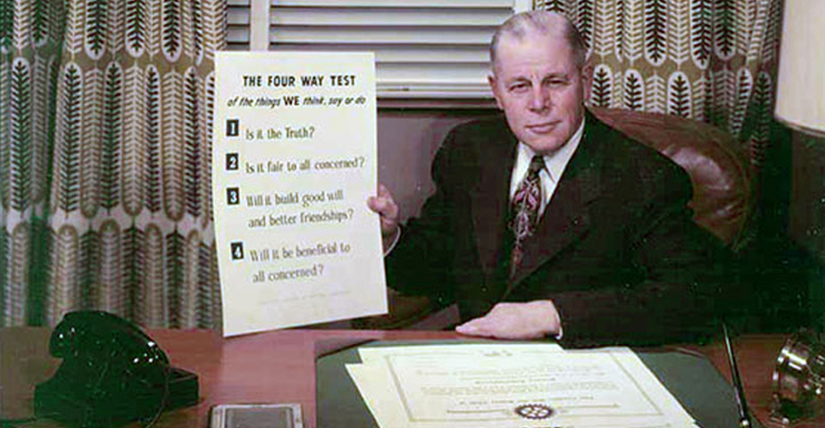
Inspired by the principle “in right there is might,” the company sought a straightforward ethical framework to complement existing policies and (impractical) code of ethics. A simple, memorable set of core values was developed, designed not to dictate actions but to serve as a test. This test would consist of questions that could guide employees in evaluating the ethical soundness of their proposed plans, policies, statements, or actions, and help identify any deficiencies. Significant effort was invested in crafting four concise questions, which ultimately became known as the “Four-Way Test.”
- Is it the truth?
- Is it fair to all concerned?
- Will it build goodwill and better friendships?
- Will it be beneficial to all concerned?
The President of Club Aluminum almost abandoned the test upon realizing how frequently he and the company’s materials deviated from the truth when he held them against the first question, “Is it the truth?” However, after two months of consistent personal application, he became convinced of its immense value, despite feeling humbled and at times disheartened by his own leadership performance. Having made sufficient progress, he felt ready to discuss it with his department heads. They agreed that the principles of truth, justice, friendliness, and helpfulness not only aligned with their personal values but would also foster greater business success. They resolved to use the Four-Way Test to evaluate all proposed plans, policies, statements, and advertising. Subsequently, all employees were instructed to memorize and integrate the Four-Way Test into their daily interactions.
Applying the Four-Way Test to advertising removed unsupported claims. This built public trust, leading to increased sales. It also changed how the company dealt with competitors; negative comments vanished, replaced by favourable comments when opportunities to do so arose, earning their trust and friendship. This consistent application of the test to all relationships—with staff, suppliers, and customers—fostered goodwill, proving that strong relationships are vital for lasting success.
Over twenty years of sincere effort by the company’s personnel led to steady progress toward the ideals of the Four-Way Test. This dedication was rewarded with a consistent increase in sales, profits, and employee earnings. What began as a bankrupt company was transformed into a thriving enterprise—repaying all debts, rewarding shareholders, and multiplying its value many times over. These achievements stemmed from a cash investment of only $6,100, the Four-Way Test, and diligent individuals who held faith in the values being tested.
The intangible benefits of using the Four-Way Test surpassed the financial ones. The company experienced a constant increase in the goodwill, friendship, and confidence of its customers, competitors, and the public. Even more valuable was a significant improvement in the character of its own personnel.
Beyond Business
The consistent application of ethical principles, specifically the Four-Way Test, throughout all business interactions has a profound and far-reaching impact. This daily practice of considering truthfulness, fairness, goodwill, and benefit to all concerned, naturally permeates beyond the professional sphere. It cultivates a virtuous cycle where ethical behavior in the workplace seamlessly translates into improved personal conduct, fostering stronger relationships within the family and social circles, and leading to more responsible and engaged citizenship. This intrinsic link between professional ethics and personal integrity explains why organizations like Rotary have embraced Herbert J. Taylor’s Four-Way Test, recognizing its power to shape individuals into more conscientious and upstanding members of both their immediate communities and society at large. The principles, once ingrained, become a guiding force in every aspect of life, ultimately contributing to a more ethical and harmonious existence.
Adapted and expanded on from Herbert J. Taylor’s own account of the Club Aluminum Company.